Thursday, June 25, 2009

In Store Reading - Part 1

Reflections on books read in store:

A Thread of Truth, Marie Bostwick
Interesting Topic. At times seemed cliche or soap opery (of course the abused wife was a run away who turned- in this case unknowingly--to stripping only be saved by  a man who appeared charming but is really  a controlling jerk). Liked the camaraderie in the town but the knitting shop which is focused on isn't as exciting as Walker and Daughter from the Friday Night Knitting Club and Knit Two. Why are so many chick lit or women's fictions books focused on knitting?  Not sure I get it.  For the record, my favorite book that involves knitting women is Ann Hood's The Knitting Room.

Baggage Claim by Tanya Michna
I liked reading a portrayal of a female academic (especially a history professor!).  I was easily drawn in by this book and the accounts of the two women in very different stages of life. Not much else to report. This is a thought provoking book.

The Widow Season by Laura Brodie
Sarah McConnell's husband had been dead three months when she saw him in the grocery store..... So begins the story of a young widow who is possibly being haunted by her husband's ghost.  This book is quite the wild ride.  A reader spends the entire story trying to determine if it's the story of a woman grieving in untraditional ways, a ghost story or the story of a man who ran away from his life.  At different points in the book I was sure of the answer and then some new detail  would make me realize I was wrong.  I've truly never read anything else like this novel.  It was full of mystery, and yet it is completely a story about love, grief and human relationships.  Additionally, the author is a talented writer. There is a true literary quality to the novel.  Upon finishing the book, I learned that Brodie has a Phd in English and wrote her dissertation on widows in English literature. According to Brodie's website, her favorite chapter was on husband's who fake their deaths in order to spy on their wives.  This explains a great deal about the unique style of this novel.  While at points I was completely perplexed by the events of this novel, and annoyed by certain passages which lead me to believe one thing was really occurring, only to be totally confused by a further event, I see that this makes the novel special. I tend to ignore paranormal fiction or science fiction, because I like novels that portray real life through a new lens. But I recognize that there is a lot to appreciate about Brodie's ability to write realistic fiction with so many twists and turns.

April & Oliver, Tess Callahan
I love the cover of this novel: the colors just captivated me. The language in this novel captivated me as well. It's a complicated story, and yet it is mostly about two individuals overcoming the events of their childhoods.  The reader deeply wants more for April, as it seems every one has failed her, and her circumstances have led her with so few opportunities. And yet she isn't bitter and angry. I think there is something I need to learn from that.  April and Oliver are in some ways "cousins" as they share a grandmother. Their fathers are half brothers but Oliver's father is not biologically related to the mother who raised him. Thus April and Oliver are not genetically related. This is important as it is obvious that Oliver longed after April during his adolescence.  The book begins with the death of Billy, April's younger brother, who she took care of and loved deeply.  The aftermath of his death leaves April alone, dealing with an abusive/stalkerish ex, a grandmother in declining health and her own grief. Oliver, returns to NY from college in California with a fiance in tow.  He is a law student and a former piano prodigy. April wonders why he isn't using his gifts.  His fiance doesn't even know about his musical talents.  I won't reveal what happens, but I was completely drawn into this book.  The characters are incredibly realistic, and human.  The writing is crisp and artful.  The story is unique from so much of the derivative stories one finds these days.

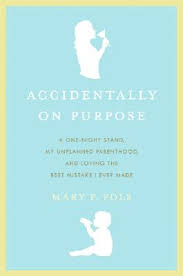
Accidently on Purpose by Mary F. Pols


Another memoir about a woman in an unexpected position.  I've been wanting to read Pols book for a while having read parts of her blog. While I found her story interesting and compelling, I wanted to be more captivated by her writing. I loved reading about her large Catholic family, her childhood in Maine, how she fell in love with being a movie critic.   I liked learning about life as a self-sufficient woman in San Francisco. I was particularly intrigued by the passages about being a late in life mother at the same time that her parents (who had her particularly late as she was the last of 6 spread out over a number of years) were failing in health. I've always found the phenomenon of the sandwich generation fascinating.  And it is obvious that Mary's parents were larger than life characters.  But I didn't find myself particularly moved by her writing style. I suppose in some ways it was too "journalistic" for my liking.  The structure seemed to make it harder for me to become totally enthralled. Maybe I am just too accustomed to fiction.

Pols book in many ways provides a slice of sociology on modern motherhood.  What is it like to share parenting responsibilities with a young slacker? What is it like to share parenting responsibilities with someone you barely know? What is it like to parent in an untraditional arrangement?  Additionally, it answers questions about raising a child far away from your extended family, and raising a child without a full cadre of grandparents. All of this is fascinating to me personally, as my parents had me late in life and I grew up largely with one grandparent (although I have so many memories of my other two grandparents who I treasured and interacted with constantly until they died when I was 6 and 7).  This book caused me to think about motherhood and my own personal time frame. It made me think about fulfillment and what I desire from family life.  It made me think about society and modern trends.  

It's hard not to want Pols to find a man to complete her life.  It is wonderful that she was able to have a child (at 40) so easily.  It is wonderful that her son has an active and involved father. But since the story unfolds completely from Pol's perspective, its hard not to feel that she deserves more than Matt, even though they are not together.  It seems that she does indeed long for a partner.  I suppose I can't help but think about the trend of single mothers raising children.  I don't have a judgement on whether this is right or wrong for their kids. I just wonder how lonely it must feel at times.  The romantic in me wants everyone to find a mate. The realist in me wonders if a mate is a necessity.

I can remember one review saying that Pols gave Matt irritable bowel syndrome because she stressed him out so much. That wasn't my take on the situation. But one does wonder: What is his perspective on the situation? In the end, it is apparent that Mary is happy with the results of the "best accident" in her life.  And it is obvious that Matt stepped up to the plate and loves Dolan. But, its impossible to know all of what he thought and felt.  It's not Pols job to provide that insight. It's just the over curious part of me that wants a scan of the bigger picture.

Thursday, June 18, 2009

Perfection by Julie Metz


I am not sure why I wanted to read this book. I guess most people are drawn in by tales of betrayal. I think the story behind this novel is horrific. It’s hard to imagine being married to someone for sixteen years and finding out that your spouse had so many secrets. It’s hard to imagine being married to someone, sharing a life with someone who could cheat on you repeatedly without you knowing. And I guess that’s what makes this book interesting: this happens so much in our country and yet people rarely talk openly about infidelity.

When Metz meets her husband’s psychiatrist the shrink explains that she believes Henry showed signs of narcissistic personality disorder. The shrink also believe his main mistress (the mother of Henry and Julie’s daughter’s best friend) has borderline personality disorder. It was interesting to consider that all sorts of wrong behavior can be explained away by psychological issues. It made me think of someone I knew in high school, who consistently cheated on his girlfriend. I actually know at least two guys who were committed to girlfriends but cheated on them more than once. One of the guys took part in this behavior with two different girlfriends. Both of these guys are incredibly intelligent. As a young college student, I just couldn’t understand. I thought: “you pick: either one girl you get every night, or a different girl every night. It’s simple.” I understand now how naïve I was --hell, I am still naïve. Love, sex – it’s all complicated and I am in no way an expert.

I am glad to know that Julie and her daughter have moved on and are finding new forms of happiness. It’s hard to read this memoir and not feel their pain. I found the writing somewhat detached. She told the story in a very straight-forward, bare bones way. It was the story itself that makes this book readable, not the writing.

Wednesday, June 17, 2009

The Richest Season by Maryann McFadden

I had read the story behind this book before I saw it on the table, and that made me instantly snap it up. I am happy McFadden found a way to publish her story and now a way to release her book to a wider audience.  I was easily drawn into the story, and very captivated by the portrayal of South Pawley's island.


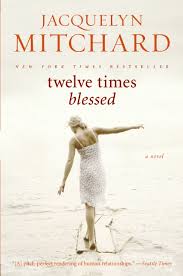
Twelve Times Blessed by Jacquelyn Mitchard

I had a four hour bus ride before me so I picked up this book and The Richest Season. I thought I had read Mitchard before and yet I can't remember which one. The beginning of this book didn't pull me in, but at some point it happened and I was typical MandN needing closure to the story at all cost, and reading when I should have been doing something else entirely. I hid out in a friend's house reading the book, happy he had something else to do, and I had time to finish before he returned.

In many ways, the main character's life is truly transformed. I suppose a near death experience can do that to you. I loved the way True's life is initially enhanced by her marriage to Hank. I didn't understand the need for a quick wedding and found it unrealistic that True would go through with such a spontaneous act without including her son (that seemed somewhat out of character). But the romance of True and Hank is inspiring and exciting. I want to believe love can happen that quickly, and can be so fulfilling. Of course, it later turns out to be incredibly complicated as well...

This book deals with so many entities that interest me: single motherhood, entrepreneurial businesses, New Orleans, infidelity, the precocious behavior of young children, life post 9/11, illness, loss of a parent, motherhood post 40. In many ways this book is so clearly modern. There may not be discussions of blackberries and facebook (it was published in 2003) but it still is clearly a product of the 2000's.

I found the relationship between True and Isabella (Esa) incredibly interesting. I love the fact that people can form families with people who aren't their blood. The extended family in this novel is wonderful. The ultra Christian mother of a young actor made me want to scream, as did the actions of True's own mother. But there are maddening and complicated individuals in this world and Mitchard seems to understand them completely.

This five hundred page plus novel seems to really blossom -- it goes from being the story of a lonely widow who sadly faces her birthday, to a story of love and friendship and overcoming obstacles with happiness and courage. In many ways the tone of the book shifts once True finds herself again, and part of that is due to the entrance of Hank.

I wish I had written my review of this book right after reading it as I feel I would have more to say. But I still highly enjoyed this book.

Commencement by J. Courtney Sullivan


In typical Marnes and Noble fashion, I sat in Borders (sorry BandN!) reading Commencement the day it came out (I am currently on vacation so I have way too much free time!) I was a hundred and fifteen pages in when I had to leave the store so I bought the book. I of course finished it in one day - the day of its publication. Such typical MandN behavior.  A day later, I am still thinking about so many of the issues this book offers insight on.  I guess since I am a twenty-something who is still trying to figure so much out, and I am deeply attached to my college group of friends this book deeply resonated with me.

I was very excited for this book since I consider it to be the same genre as A Fortunate Age. One of my friends didn't love A Fortunate Age.  I understand her criticisms but I happily devoured Smith-Rakoff's book.  My first thought when finishing it was that I wanted to read it again. Part of my love may come from its focus on NYC in the 1990s. In many ways, NYC was a character in the book. And I miss NYC dearly.

As for Commencement: to me this is a genre I treasure. The story of a group of friends post-college. It is a time period I have wanted to capture myself and I suppose I still hope to someday.  It is hard to read Commencement and not feel nostalgic for college, especially since I have entered somewhat of a quarter life crisis in my twenty fifth year.  Interestingly, both Commencement and A Fortunate Age focus on students who attend liberal arts colleges. Having attended an Ivy, I wonder how different my experiences and my career path would have been if I attended a small liberal art's college. I never really considered attending a liberals arts college; but I think I may have been happy at one. (Not that I didn't love my own college experience, as I did, thoroughly).  In many ways the book focuses on how random events change individuals. If the four protagonists had not chosen to attend Smith, or been randomly placed in the same house (in the maid's quarters) they would have had completely different experiences. In one passage of the book, it is very obvious that Bree and her family recognizes that Smith forever altered her in ways that were unimaginable before hand.  Sally, on the other hand, is most affected by the death of her mother right before her high school graduation.  In many ways, the absence of her mother affects all of Sally's behaviors and decisions, and she realizes that much of what she had done since her mother's death was "an attempt to shock her back to life" (an affair with a married professor, not applying to medical school, her bare bones wedding in the Smith College Quad). (pg. 115)  April's determined and extreme personality and hardcore feminism is a  result of her tumultuous  upbringing and the absence of supportive family and friends. Celia, on the other hand, is greatly affected by her large nurturing family, her supportive and successful mother, a rape experience and her unique view on men.  

This book provided a clear window on the Smith experience and it had me nostalgic for my college's own traditions.  But I also loved living through the four years of college with these interesting and disparate women.  I found it particularly interesting to consider how attending an all-girls college affects hook up culture and women's perception of men.  The book highlights (through a theory of Celia's) the idea that some "women's college grads are like people who had lived through the Depression -- even though they now had plenty of food, they still hoarded every last scrap." Celia explains: "when she met a guy, any guy, she was too willing to accept his flaws because who knew where her next meal was coming from?" (pg. 213) The book also offers such interesting views on feminism.  Feminism is something that the girls clearly grappled with extensively at Smith. I am not sure I can say that I did the same during my four years of college. I took a Gender Studies class, and a Women's history course, I worked for a group that promoted positive body image, a group that invited Naomi Wolf to speak on campus (and of course I was in the audience) and I participated in Take Back the Night Walks. But I still don't feel that feminism is something my friends understood or grappled with in college . At this point in our lives, we are certainly considering the idea of our choices and we obviously see that we have many more options than previous generations. But I can't say that any of my friends are feminists, or that they feel the most strongly about women's issues. It is something interesting to compare and contrast. The women at Smith clearly cared less about their appearances and experimented more with their sexuality. The culture at my college was much more materialistic and into appearances and the hook up culture was much more "heteronormative."

The inside book cover proclaims that this novel is "a portrait of the first generation of women who have all the opportunities in the world, but no clear idea what to choose."  This is an interesting idea to consider. I suppose this is true of my friends and the people I grew up with, and I suppose I know many woman who havemade choices that seem archaic.  Sullivan deftly portrays keen insight on our shared generation. She shows women who are interested in snatching a husband and others who don't believe they will ever find a man who compliments them. Celia, is in many ways a true modern woman, as she doesn't long for marriage and feels that she is a different version of herself (Celia 2.0) among men.  I can remember feeling my female friends in college knew me best.  There have only been a small group of men who have understood me in the same way. But the optimist in me does believe there is someone out there (and many somebodies at that) out there for everyone, even Celia.

Sullivan is quite insightful. So many of her ideas were things I had considered before but she packages them in creative new ways. She describes the girl's experiences their first year out of college as their freshman year, and each subsequent year as their sophomore, junior, senior year. I liked this idea greatly.  There is so much uncertainty post college. Maybe our culture has infantilized young people, or maybe adolescence has been delayed or extended, but so much of post college life is challenging and unique. Even now, a full four years out of college, I am still trying to figure out what I want in life.  In some ways, it is hard to read about the protagonists of this novel. They all seem so sure of their career choices: Bree is a lawyer and followed her dreamed path from Smith to Stanford; Celia wants to be a writer and she works in publishing while eventually making time to write on the side; April eventually works for a radical feminist, partaking in crazy experiences, but acting out of a deep passion for her work; Sally, may have given up on her dream to go to med school but she is still connected to the science world, working in a lab at Harvard. Sally also seems content to build a new family for herself with her doting husband Jake.  She is certain in that decision, even if she recognizes that she has given up on some of her initial dreams.  The truth is they all do stumble, being surprised by unexpected events, making spontaneously bad and good decisions.  But I was envious of how much each of them had a sense of certainty about what they wanted.  

I love the insights and observations Sullivan shares about women in New York City. Her passage about the fact that most of the women looking for husbands worked in marketing had me laughing and nodding my head in agreement.  Her discussion of dating in New York is filled with colorful characters like Barrel Daryl. All single  women in NYC have some similar stories; Sullivan's don't disappoint.

I really have so much to say about this book. I found it interesting the way Sullivan discusses the young women's dependancy on their parents and the idea that all of them are supported somewhat by their parents but do not discuss it.  Sally, has received money due to her mother's death (malpractice suit) and yet lives a pretty typical life - which is interesting but realistic.  I am still grappling with the ending which didn't provide as much closure as I wanted (I turned the last page dreading seeing the Acknowledgements, knowing there was no more but wishing otherwise).  I was easily drawn into this novel. I love the characters - I loved the way the friends are shown to be family to one another, the way they mothered one another.  I can remember that about college: the way friends replace your parents as the people you call during big and small events.

I have some additional thoughts about the surprises in the end but I don't want to ruin the ending for people who want to read the book.  I thought the book was going to go in one direction that made me amused in its similarity to A Fortunate Age, but it actually changed course. In reality, there are some amusing similarities. Both books focus on the first engagement and wedding of one of the friends.  What does this say about life as a twenty-something post college?  In A Fortunate Age, there is discussion of the fact that it is hard when your first friend becomes married because there is a sense that you are losing something, that your group of friends is changing.  I am intrigued by this idea. In Commencement, the girls at first don't think Jake is smart enough for Sally. But in the end, it is obvious that he loves Sally and deeply appreciates the same thing that Sally's girlfriends love about her.  He takes care of her and helps her to remember her mother, something her own family does not do.  In the end he proves himself to the girls and thus, he becomes a "Smithie."  A Fortunate Age spans a longer time period (and takes place in an earlier time period) and so by the end of the book almost all of the main characters are married with children. It is a natural progression I suppose.  But it is interesting to consider. The first friend married in my group of college friends was a male and thus the effect was not the same.  The first married girls, married individuals from our group, boys they dated throughout college and thus there was less a sense of loss, less a sense of altering the dynamics of the group. All of this is interesting to consider.  

So much to ponder. I need my college friends to read this book so we can discuss!

Monday, June 15, 2009

Driftwood Summer by Patti Callahan Henry


Patti Callahan Henry never disappoints. One day I picked up one of her books off a New Fiction table, and two chapters in and I just knew I would read all of her books. I devoured her latest book in one day finishing it at 4 in the morning.  I am not sure I can put my finger on exactly what makes her stories so readable, but her characters and settings always easily draw me in.

This book focuses on the relationship between sisters, something I cannot relate to at all as I only have brothers. But I still find it inherently amusing. I suppose a lot of women's fiction focuses on the relationship between sisters, in fact Kristin Hannah's last book focused on three sisters as well.  And yet, Callahan Henry's books never seem cliche or derivative.  Even though many of her books seem to replay similar ideas or conflicts, they are each unique.

The book also focuses on a small town book store, something I know I would love. I loved my local bookstore as a child--it was called The Corner Book Shop and I spent most of my childhood weekends inside its doors.

At the heart of it this book focuses on how the events of adolescence and childhood stay with an individual - something focused on in most of Callahan Henry's books. She understands young love in such an obvious way.  This book also focuses on the sandwich generation, and adults dealing with the sickness of their parents.  Callahan Henry grapples with so many issues in this book, and yet the heart of the story is the deep friendship between Mack and Riley and the rift between Riley and Maisy. I suppose it isn't a new story - sisters fight over boy, boy chooses beauty over best friend. And yet, as I said before Callahan Henry's stories always seem new.